


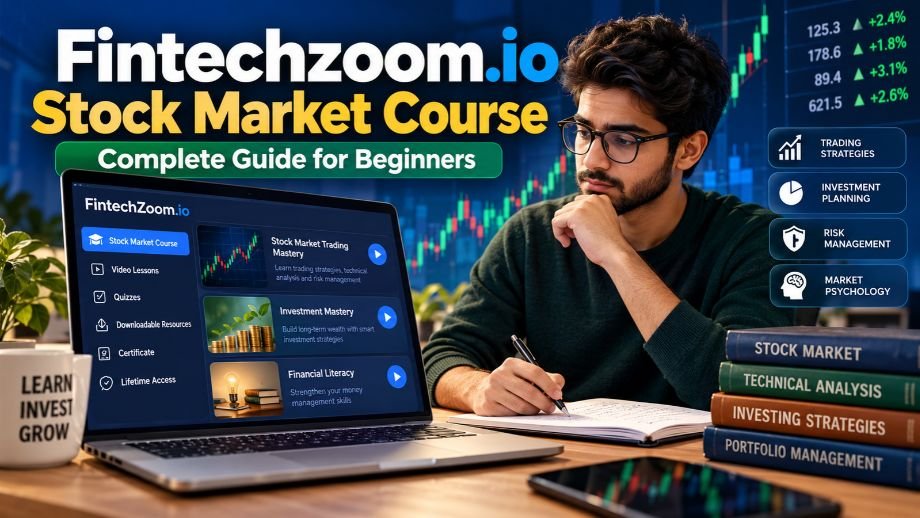
Learning how the stock market works is an important first step for anyone interested in trading or long-term investing. However, choosing the right educational program can be challenging, especially when online courses promise to simplify complex financial concepts. The Fintechzoom.io Stock Market Course is one option attracting attention from beginners who want to understand financial markets, trading strategies, and investment planning.
FintechZoom.io advertises several financial education programs, including courses focused on stock market trading and investing. These programs cover subjects such as technical analysis, portfolio management, market trends, and risk management. They are presented as self-paced learning opportunities for people with different levels of financial knowledge.
However, prospective students should understand what these courses actually offer before enrolling. Important questions remain about pricing, instructor qualifications, independent student feedback, and the identity of the course provider.
This guide examines the advertised curriculum, learning features, potential benefits, limitations, and safety considerations associated with the Fintechzoom.io Stock Market Course. It also explains how the trading and investing programs differ and what beginners should verify before making a payment.
What Is the Fintechzoom.io Stock Market Course?
The Fintechzoom.io Stock Market Course refers to online financial education programs advertised through FintechZoom.io, a website covering financial markets, stocks, cryptocurrencies, and related financial topics.
Rather than offering one program under this exact name, the website lists multiple educational courses. Two are particularly relevant to people interested in the stock market: the Stock Market Trading Mastery Course and the FintechZoom Investment Mastery Course.
The trading program focuses on understanding price movements, technical indicators, trading strategies, and market risks. The investing program concentrates on building portfolios, evaluating financial assets, and developing longer-term investment strategies.
Both are advertised as suitable for beginners and intermediate learners. Their published descriptions mention video lessons, downloadable materials, assessments, and completion certificates.
These details describe what the provider advertises. They do not independently establish the quality of the lessons, the qualifications of the instructors, or the outcomes experienced by students.
What Courses Does FintechZoom.io Offer?
FintechZoom.io advertises three main financial education categories. Although they address related subjects, each serves a different learning objective.
1. Stock Market Trading Mastery Course
The Stock Market Trading Mastery Course is designed for people interested in understanding how traders analyze markets and make decisions about buying and selling financial instruments.
Its advertised curriculum includes technical analysis, candlestick patterns, trading strategies, risk management, and trading psychology.
The program introduces different trading approaches, including day trading, swing trading, and position trading. It also discusses market indicators, trading platforms, and the influence of financial news on price movements.
According to the provider’s course description, the program contains approximately four to six hours of video instruction.
This duration suggests that the course may serve as an introduction to several trading concepts. However, the depth of instruction cannot be determined without reviewing the actual lessons.
2. FintechZoom Investment Mastery Course
The FintechZoom Investment Mastery Course takes a broader approach to financial markets.
Instead of concentrating primarily on short-term price movements, it covers investment planning, asset allocation, portfolio construction, and wealth-management concepts.
The advertised subjects include stocks, bonds, exchange-traded funds, mutual funds, diversification, investment valuation, and behavioral finance.
It also introduces more advanced topics such as derivatives, international investing, hedging, and automated investment tools.
The provider advertises approximately seven to eight hours of video instruction.
For beginners interested in long-term investing rather than frequent trading, this curriculum may be more closely aligned with their objectives.
3. Financial Literacy Course
The Financial Literacy program addresses broader personal finance topics.
Financial literacy generally involves understanding how to manage money, evaluate financial decisions, and recognize financial risks.
This foundation is particularly valuable for people who have never invested before.
Before learning advanced trading techniques, beginners should understand essential concepts such as emergency savings, debt management, investment risk, and the relationship between potential returns and potential losses.
The existence of a financial literacy program does not mean students must complete it before enrolling in the stock-focused courses. However, developing these foundational skills can make more advanced financial subjects easier to understand.
Fintechzoom.io Stock Market Course Curriculum
One of the most important considerations when evaluating a stock market course is its curriculum.
A useful program should explain not only financial terminology but also how different concepts relate to real investment decisions.
The advertised FintechZoom.io curriculum covers several important areas.
Stock Market Fundamentals
Understanding the structure of financial markets is essential before buying or selling securities.
Beginners need to know what stocks represent, how exchanges operate, and why share prices change.
A stock represents an ownership interest in a company. Its market price can fluctuate because of business performance, investor expectations, economic conditions, and changes in supply and demand.
Important foundational concepts include:
- Stocks, shares, and market capitalization.
- Stock exchanges and brokerage accounts.
- Market orders and limit orders.
- Bid and ask prices.
- Trading volume and liquidity.
- Market volatility.
- Investment returns and losses.
Understanding these concepts helps beginners interpret market activity without assuming that every price movement represents a profitable opportunity.
Technical Analysis and Chart Reading
Technical analysis is a major component of the advertised trading program.
It involves examining historical price movements, trading volume, and market patterns to evaluate possible future price behavior.
The curriculum introduces candlestick charts, trend identification, and technical indicators.
Candlestick charts display price information over a particular period, including opening, closing, highest, and lowest prices.
Traders use these charts to identify patterns and evaluate market sentiment.
Other common technical-analysis concepts include support and resistance, moving averages, momentum, and trend direction.
However, technical indicators do not reliably predict future market movements. A pattern that appeared profitable in historical data may fail under different market conditions.
Beginners should treat technical analysis as a decision-support method rather than a guarantee of successful trades.
Day Trading, Swing Trading, and Position Trading
The trading course introduces several approaches to participating in financial markets.
Day trading involves opening and closing positions within the same trading day. Traders often focus on short-term price movements and may execute multiple transactions.
This approach requires considerable attention, discipline, and risk management. Frequent transactions can also increase trading costs.
Swing trading generally involves holding positions for several days or weeks to capture larger price movements.
Swing traders may use technical analysis alongside broader market information. Because positions remain open overnight, unexpected news can create additional risk.
Position trading involves holding positions over longer periods, sometimes for months.
This approach often considers broader trends and economic developments rather than minute-by-minute price changes.
The best approach depends on a person’s objectives, available time, experience, and tolerance for losses.
No trading style guarantees profitability.
Risk Management and Capital Protection
Risk management is among the most valuable subjects included in the advertised curriculum.
Financial markets are unpredictable, and even experienced investors experience losses.
A trading strategy should therefore include clear rules for managing exposure.
Common risk-management concepts include position sizing, diversification, stop-loss orders, and maintaining appropriate cash reserves.
A stop-loss order can help limit losses by triggering an order when a security reaches a specified price. However, execution at that exact price is not guaranteed, particularly during volatile markets or price gaps.
Position sizing involves determining how much capital to allocate to an individual trade.
Concentrating too much money in one position can expose a portfolio to substantial losses.
The curriculum also introduces margin trading, which involves using borrowed funds.
Margin can amplify gains, but it can also magnify losses and create additional financial obligations.
Beginners should understand these risks before considering leveraged trading.
Trading Psychology and Emotional Discipline
Financial decisions are influenced by human behavior.
Fear, greed, impatience, and overconfidence can affect how investors respond to changing market conditions.
For example, a trader may hold a losing position longer than planned because accepting the loss feels uncomfortable.
Another trader may enter a position impulsively after seeing a rapid price increase.
Trading psychology focuses on recognizing these behavioral patterns and developing more consistent decision-making processes.
A trading journal can help learners review decisions, identify recurring mistakes, and evaluate whether they are following their intended strategies.
However, emotional discipline alone cannot turn an ineffective trading strategy into a profitable one.
Portfolio Management and Asset Allocation
Portfolio management receives greater emphasis in the investing program.
A portfolio is a collection of financial assets owned by an investor.
Asset allocation involves deciding how to distribute investments among categories such as stocks, bonds, cash, and other assets.
Diversification can help reduce exposure to the performance of a single investment.
For example, an investor who owns shares in only one company faces greater company-specific risk than someone holding a diversified collection of securities.
However, diversification cannot eliminate all investment risk.
Portfolio management also involves monitoring investments and periodically reviewing whether the allocation remains consistent with financial goals.
Fundamental Analysis and Investment Valuation
The investing curriculum introduces methods for evaluating financial assets.
Fundamental analysis involves examining a company’s business operations, financial condition, competitive position, and future prospects.
Investors may review financial statements, revenue growth, profitability, debt levels, and cash flow.
Valuation techniques help investors assess whether a security’s market price appears reasonable relative to its underlying business characteristics.
The investing program also introduces value investing and dividend-focused strategies.
Value investing generally involves searching for securities believed to trade below their estimated intrinsic value.
Dividend investing emphasizes companies that distribute part of their earnings to shareholders.
Neither strategy guarantees positive returns. An apparently inexpensive stock may remain undervalued or decline further, while dividend payments can be reduced or discontinued.
Advanced Trading and Investment Topics
The advertised curricula extend beyond basic stock market education.
Additional subjects include algorithmic trading, options, futures, foreign exchange, hedging, international investing, environmental and social investment considerations, and artificial intelligence in finance.
These topics can be useful introductions to the wider financial industry.
However, many require substantial independent study.
Options and futures, for example, involve contractual arrangements that can create complex risk exposures.
Algorithmic trading may require knowledge of programming, market data, strategy testing, and execution systems.
Artificial intelligence can assist with data analysis, but it does not remove uncertainty from financial forecasting.
The inclusion of these topics should not be interpreted as proof that a relatively short course provides professional-level expertise in every area.
Fintechzoom.io Trading Course vs. Investing Course
The two stock-focused programs address different financial objectives.
| Feature | Trading Mastery Course | Investment Mastery Course |
|---|---|---|
| Main objective | Understanding active trading | Understanding investment planning |
| Advertised duration | 4–6 hours | 7–8 hours |
| Technical analysis | Major focus | Less central |
| Day trading | Covered | Not a primary focus |
| Swing trading | Covered | Not a primary focus |
| Portfolio construction | Some coverage | Major focus |
| Asset allocation | Covered | Major focus |
| Long-term investing | Limited emphasis | Stronger emphasis |
| Behavioral concepts | Trading psychology | Behavioral finance |
| Advanced subjects | Algorithmic trading, options, forex | Derivatives, hedging, international investing |
| Intended learners | Aspiring traders | Aspiring investors |
Which Course Is Better for Beginners?
The answer depends on what the learner wants to achieve.
Someone interested in understanding short-term market movements may find the trading curriculum more relevant.
Someone focused on retirement planning, diversification, or long-term wealth accumulation may benefit more from the investing curriculum.
For complete beginners, learning basic personal finance and investment risk should generally come before attempting complex trading strategies.
The comparison above reflects the advertised subjects, not independently verified teaching quality.
Fintechzoom.io Stock Market Course Features
The provider advertises several features intended to make its courses accessible to online learners.
Self-Paced Learning
The courses are described as self-paced, allowing students to study according to their schedules.
This format may appeal to working professionals and people who cannot attend fixed classroom sessions.
However, self-paced education requires personal discipline. Without regular study and practice, learners may struggle to retain unfamiliar financial concepts.
Video Lessons and Downloadable Materials
The course descriptions mention recorded video lessons and supplementary learning materials.
These reportedly include charts, worksheets, and strategy-related resources.
Such materials can help learners review important concepts outside the main lessons.
The quality, completeness, and practical usefulness of these resources have not been independently established.
Interactive Quizzes
Quizzes are advertised as part of the learning experience.
Assessments can help students identify areas they understand and subjects requiring further study.
However, passing a course quiz does not demonstrate that someone can manage real financial risk or trade profitably.
Course Completion Certificates
FintechZoom.io advertises certificates of completion.
A completion certificate generally indicates participation in or completion of a particular educational program.
It should not automatically be considered equivalent to an accredited academic qualification, professional investment certification, or financial-services license.
Independent recognition or accreditation of these certificates has not been established.
Lifetime Access and Course Updates
The general courses page advertises lifetime access and course updates.
These features could be useful because financial markets, regulations, and trading technologies change over time.
However, prospective students should verify whether lifetime access applies to the specific program they intend to purchase.
They should also confirm what happens if the website changes ownership, discontinues a course, or stops operating.
The frequency and scope of curriculum updates have not been independently verified.
How Much Does the Fintechzoom.io Stock Market Course Cost?
Pricing is an important consideration for anyone evaluating an online educational program.
However, a definitive public enrollment price for the Fintechzoom.io Stock Market Course could not be independently verified from the available research.
This means it would be misleading to publish a specific course fee without additional confirmation.
The website has also referenced access to a free course, but that does not establish that its complete trading or investing programs are available without payment.
Before enrolling, prospective students should confirm the full cost and whether any additional expenses apply.
Potential expenses to investigate include software subscriptions, market-data services, advanced learning modules, and certificate fees.
These are general considerations, not confirmed charges imposed by FintechZoom.io.
Is the Fintechzoom.io Stock Market Course Free?
The available information does not establish that both advertised stock market programs are entirely free.
Students should distinguish between free introductory material and full access to a structured course.
A free lesson, educational article, or promotional offer does not necessarily include the complete curriculum.
The safest approach is to obtain written confirmation of what is included before registering or paying.
Does FintechZoom.io Offer Refunds?
The general courses page advertises a 30-day satisfaction guarantee.
However, the available research does not independently establish how this guarantee operates for each stock market program.
Important details remain unclear, including eligibility conditions, refund-processing times, and whether restrictions apply after accessing or downloading course materials.
Students should request the complete refund policy before making a payment.
Written terms provide a clearer basis for understanding what protections are available if the course does not meet expectations.
Who Teaches the Fintechzoom.io Stock Market Course?
Instructor qualifications are particularly important in financial education.
An experienced instructor should be able to explain financial concepts accurately, discuss the limitations of different strategies, and distinguish educational examples from personalized investment advice.
FintechZoom.io advertises expert-led instruction, but the available research does not independently establish the identities and professional qualifications of the instructors responsible for the stock market programs.
Prospective students should look for verifiable biographies, relevant professional experience, and examples of previous educational work.
Claims of trading success should also be evaluated carefully.
Someone who describes themselves as a successful trader is not necessarily an effective instructor, and past investment performance does not guarantee future results.
Is Fintechzoom.io Stock Market Course Legit and Safe?
This is one of the most important questions surrounding the course.
FintechZoom.io operates publicly accessible pages describing financial education programs. However, the existence of these pages does not independently verify the quality of course delivery, customer support, or payment protection.
There is also an important distinction between FintechZoom.io and FintechZoom.com.
FintechZoom.io vs. FintechZoom.com
FintechZoom.com has published a notice identifying its official website and stating that FintechZoom.io is not affiliated with it.
The notice warns readers about confusion involving similarly named domains and the potential misuse of financial information.
This does not independently prove that the courses advertised on FintechZoom.io are fraudulent.
However, it is a significant reason to verify the identity of the business responsible for collecting payments and delivering educational services.
Students should not assume that two websites sharing a similar name are operated by the same company.
Website Trust Scores and Their Limitations
Automated website-assessment services have also raised concerns about FintechZoom.io.
For example, ScamAdviser has displayed a low trust assessment for the domain.
Such evaluations may consider registration information, website popularity, technical characteristics, and other risk indicators.
However, automated scores have limitations.
A private domain registration does not automatically indicate fraud, and a valid SSL certificate does not establish that a business is trustworthy.
These assessments should be considered alongside official disclosures, independently verified business information, and documented customer experiences.
What Should Students Verify Before Paying?
Before purchasing any online financial education course, prospective students should establish several essential facts:
- The legal name and contact information of the business operating the course.
- The identity and qualifications of the instructors.
- The complete curriculum and available lesson previews.
- The full price and any recurring charges.
- The written refund and cancellation terms.
- The duration of course access.
- The type and recognition of any certificate.
- The availability of customer support.
- The payment methods and transaction protections.
- Whether independent student feedback can be verified.
If important information cannot be obtained, delaying enrollment may be more prudent than making a payment based solely on promotional claims.
Fintechzoom.io Stock Market Course Reviews
Several websites have published reviews and guides discussing the FintechZoom.io stock market programs.
These articles commonly examine the advertised curriculum, beginner suitability, pricing uncertainty, and website credibility.
However, the available research does not establish a substantial collection of independently verified reviews from students who completed the courses.
It also does not establish independently tested teaching quality or documented graduate outcomes.
This distinction matters because an online review may be based entirely on publicly available course descriptions.
Such an article can still provide useful information, but it should not be confused with a firsthand evaluation.
What Do the Available Reviews Suggest?
The publicly available editorial coverage identifies potentially useful educational subjects, particularly for beginners seeking an introduction to trading and investing.
At the same time, reviewers have raised questions about pricing transparency, instructor credentials, and the information available before enrollment.
These observations support further investigation rather than a definitive positive or negative judgment.
Until more verifiable student experiences become available, readers should avoid relying on unsupported satisfaction ratings or claims of exceptional learning outcomes.
Benefits of the Fintechzoom.io Stock Market Course
Based on its advertised structure, the course has several potential advantages.
Broad Financial Education
The curricula introduce a wide range of financial concepts, from stock market fundamentals to portfolio management and advanced trading subjects.
This breadth may help beginners identify areas they want to explore further.
Flexible Learning
The advertised self-paced format may suit people balancing education with employment or other commitments.
Recorded lessons can also allow learners to revisit unfamiliar concepts.
Trading and Investing Options
Offering separate trading and investing programs gives prospective students a choice between different learning objectives.
This distinction is useful because active trading and long-term investing require different approaches to financial decision-making.
Emphasis on Risk Management
The advertised inclusion of risk management and behavioral finance is relevant to responsible financial education.
Understanding losses, volatility, and emotional decision-making is essential before participating in financial markets.
Supplementary Learning Materials
Quizzes, worksheets, and downloadable resources could support independent study.
However, the actual quality of these materials remains unverified.
Potential Drawbacks and Limitations
The most significant limitations concern information that has not been independently established.
Limited Pricing Transparency
Without a verified public enrollment fee, prospective students may find it difficult to compare the program’s value with alternative courses.
Unverified Instructor Credentials
The lack of independently established instructor qualifications makes it harder to assess teaching expertise.
Broad Curriculum Within Limited Video Hours
The trading and investing programs advertise many substantial topics within relatively short video durations.
Although this may be sufficient for introductory explanations, it does not demonstrate comprehensive mastery of complex subjects.
Unclear Certificate Recognition
Completion certificates may document participation, but external accreditation or professional recognition has not been established.
Limited Independent Student Feedback
Without substantial verified student reviews, it is difficult to assess lesson quality, support responsiveness, or actual learning outcomes.
Domain Identity Concerns
The published warning from FintechZoom.com introduces an additional credibility consideration that prospective students should investigate.
These limitations do not establish that the courses are ineffective. They indicate that important information remains unavailable or insufficiently verified.
Can the Fintechzoom.io Stock Market Course Make You a Successful Trader?
Completing a financial education course does not guarantee trading success.
Profitable trading depends on numerous factors, including market conditions, strategy quality, risk management, transaction costs, and individual decision-making.
Even a well-designed educational program cannot eliminate uncertainty.
Beginners should be especially cautious about interpreting examples of profitable trades as evidence that similar results can be reproduced consistently.
Historical performance, simulated results, and backtested strategies may not reflect real trading conditions.
Actual markets involve commissions, spreads, slippage, emotional pressure, and unexpected developments.
A useful course should help learners understand these limitations rather than promise predictable financial returns.
The available research does not establish verified trading-performance results for graduates of the FintechZoom.io programs.
Therefore, claims that completing the course will produce consistent profits would be unsupported.
Best Alternatives to the Fintechzoom.io Stock Market Course
People interested in learning about investing have several other educational options.
Some are free resources designed for beginners, while others provide more structured professional education.
SEC Investor.gov
Investor.gov is an educational resource operated by the U.S. Securities and Exchange Commission.
It provides information about investment products, financial risks, fraud prevention, and investor protection.
Beginners can use it to understand fundamental investment concepts and learn how to evaluate potentially misleading financial claims.
It is particularly useful for developing a cautious approach to investing before considering paid education.
FINRA Investor Education
The Financial Industry Regulatory Authority provides investor education covering financial markets, investment products, and investor protection.
Its educational materials help retail investors understand common financial risks and make more informed decisions.
These resources are particularly valuable for people who want to understand the practical responsibilities associated with investing.
CFA Institute Investment Foundations Certificate
The CFA Institute offers an Investment Foundations Certificate designed to introduce learners to the investment industry.
Its curriculum includes financial markets, investment instruments, ethics, and industry operations.
The program provides a more formally structured learning pathway than a collection of general financial articles.
CFA Institute has published an estimated study duration of 35–65 hours and a standard enrollment price of $350, with a discounted offer for eligible students.
These are provider-published details and should be checked for changes before enrollment.
The Investment Foundations Certificate is not equivalent to earning the CFA charter.
Khan Academy Financial Literacy
Khan Academy offers accessible educational resources covering financial literacy and personal finance.
Its materials can help beginners develop foundational knowledge before exploring complex investment strategies.
This approach may be especially appropriate for people who have never managed an investment portfolio or used a brokerage account.
Paper Trading and Simulated Investing
Paper trading allows learners to practice investment decisions using simulated funds rather than real money.
Some brokerage platforms offer virtual trading environments that resemble actual market conditions.
These tools can help beginners understand order types, price movements, and basic portfolio tracking.
However, simulated performance does not fully reproduce the emotional and financial consequences of real trading.
Paper trading should be viewed as a learning tool, not proof that a strategy will remain profitable with real capital.
How to Choose the Right Stock Market Course
Selecting a financial education program should begin with a clear understanding of personal learning objectives.
Someone interested in retirement investing may need a different curriculum from someone studying technical trading strategies.
The first consideration is whether the course matches the learner’s existing knowledge.
A complete beginner may benefit more from basic financial education than from advanced derivatives or algorithmic trading.
The second consideration is instructional quality.
Look for clearly identified instructors, transparent course outlines, sample lessons, and realistic explanations of financial risk.
The third consideration is cost.
An expensive course is not automatically better than a free educational resource. Its value depends on the quality of instruction, practical exercises, support, and relevance to the learner’s goals.
Finally, consider whether the provider makes unrealistic promises.
Claims of guaranteed profits, risk-free strategies, or unusually consistent returns should be treated with skepticism.
A credible educational program should help students understand uncertainty rather than suggest that financial losses can be eliminated.
Is the Fintechzoom.io Stock Market Course Worth It?
The answer depends on what can be verified before enrollment.
The advertised curricula include subjects relevant to beginners interested in stock trading and long-term investing.
The distinction between trading and investing programs is also useful because these activities involve different objectives and risks.
However, the available evidence does not establish enough about pricing, instructor qualifications, independent student experiences, or course delivery to make a confident recommendation to purchase.
The domain-affiliation warning from FintechZoom.com is another important consideration.
Prospective students should therefore evaluate the course as an educational offering whose advertised features are publicly documented but whose overall quality and purchase experience remain insufficiently verified.
For complete beginners, established financial education resources may provide a practical starting point while these questions remain unresolved.
Anyone considering paid enrollment should obtain the relevant terms in writing and verify the identity of the provider before sharing payment information.
Final Thoughts
The Fintechzoom.io Stock Market Course presents an educational offering covering several important areas of trading and investing. Its advertised programs introduce financial market fundamentals, technical analysis, trading psychology, portfolio management, and investment strategies.
The course structure may appeal to beginners looking for an introduction to financial markets, particularly those who prefer self-paced online learning.
However, course descriptions alone cannot establish teaching quality or value for money.
Pricing uncertainty, unverified instructor qualifications, limited independent student feedback, and the documented domain-affiliation warning are important considerations.
Before enrolling, prospective students should confirm the provider’s identity, review the complete curriculum, understand all payment and refund terms, and evaluate whether the program matches their learning objectives.
For beginners, the most valuable starting point is not necessarily an advanced trading strategy. It is a sound understanding of financial markets, investment risk, diversification, and responsible decision-making.
A course can provide useful knowledge, but successful investing ultimately requires informed judgment, realistic expectations, and ongoing learning.
Frequently Asked Questions
1. What is the Fintechzoom.io Stock Market Course?
The Fintechzoom.io Stock Market Course refers to financial education programs advertised through FintechZoom.io. Its two main stock-focused programs cover trading strategies and investment planning. The website also advertises a broader Financial Literacy course.
2. Is the Fintechzoom.io Stock Market Course suitable for beginners?
The provider advertises its trading and investing programs as suitable for beginners. However, the curricula also include advanced subjects that may require additional study. Beginners should develop foundational financial knowledge before attempting complex trading strategies.
3. How much does the Fintechzoom.io Stock Market Course cost?
A definitive enrollment price could not be independently verified from the available research. Prospective students should request the complete current fee and confirm whether additional charges apply.
4. Is the Fintechzoom.io Stock Market Course free?
The website has referenced access to a free course, but this does not establish that the complete Stock Market Trading or Investment Mastery programs are free. Students should confirm exactly what is included in any free offer.
5. How long does the course take to complete?
The trading program advertises approximately four to six hours of video lessons, while the investing program advertises seven to eight hours. Actual completion time may vary depending on quizzes, exercises, and additional study.
6. Does FintechZoom.io provide certificates?
The website advertises completion certificates for its courses. However, independent professional accreditation or external recognition of these certificates has not been established.
7. Is FintechZoom.io the same as FintechZoom.com?
No affiliation should be assumed. FintechZoom.com has publicly stated that FintechZoom.io is not affiliated with its official website. Prospective students should independently verify the identity of the organization operating the .io courses.
8. Is the Fintechzoom.io Stock Market Course legitimate?
The website publicly advertises identifiable educational programs, but important information about the operator, instructor credentials, student outcomes, and purchase experience remains unverified. The available evidence does not justify a definitive conclusion that the courses are either legitimate or fraudulent.
9. Can beginners learn stock trading through the course?
The advertised curriculum introduces stock market fundamentals, technical analysis, trading strategies, and risk management. However, the effectiveness of the actual instruction has not been independently established. Learning these concepts also does not guarantee profitable trading.
10. Does FintechZoom.io offer a refund policy?
The general courses page advertises a 30-day satisfaction guarantee. Prospective students should obtain the complete written terms and verify whether the guarantee applies to their chosen program before purchasing.
11. What is the difference between the trading and investing courses?
The trading course emphasizes market analysis, technical indicators, and active trading strategies. The investing course focuses more on portfolio construction, asset allocation, financial planning, and long-term investment principles.
12. Are there better alternatives for beginners?
Established educational resources such as SEC Investor.gov, FINRA Investor Education, Khan Academy, and CFA Institute programs provide alternatives. The most appropriate option depends on the learner’s objectives, budget, and preferred level of instruction.
